
GOTS vs OEKO-TEX: The Complete Guide to Organic Baby Clothing Certifications in India
Everything Indian parents need to know about baby clothing certifications, what they actually mean, and how to verify them before you buy.
When you're shopping for your newborn's first clothes, you'll see labels everywhere — "organic cotton," "chemical-free," "certified safe." But what do these certifications actually mean? Are they all equally trustworthy? And most importantly, how do you know if a brand is telling the truth?
As parents ourselves, we spent months researching fabric certifications before launching Cozy Bear. This guide shares everything we learned — no marketing fluff, just facts that help you make informed decisions for your baby.
Why Baby Clothing Certifications Matter in India
India's textile industry is the world's second-largest. While this means abundant choice, it also means varying quality standards. A 2023 study by the Centre for Science and Environment found that many "organic" labels in India lack third-party verification.
For baby clothing specifically, certifications matter because:
Newborn skin is 30% thinner than adult skin. This means chemicals absorb faster and deeper. What touches your baby's skin for 16+ hours daily matters enormously.
Conventional cotton uses 16% of the world's insecticides. Residues can remain in finished fabric. For babies with developing immune systems, minimizing chemical exposure is prudent.
"Organic" without certification is just a marketing word. In India, there's no legal requirement to prove organic claims on clothing. Only third-party certifications provide verification.
Understanding GOTS Certification
What is GOTS?
GOTS stands for Global Organic Textile Standard. It's the world's leading textile processing standard for organic fibres. Established in 2006, GOTS is recognized in over 80 countries.
What GOTS Certification Guarantees
For a product to carry the GOTS label, it must meet requirements across the entire supply chain:
Fibre Content:
- "Organic" label: minimum 95% certified organic fibres
- "Made with organic" label: minimum 70% certified organic fibres
Chemical Restrictions:
- No toxic heavy metals (lead, cadmium, mercury)
- No formaldehyde
- No aromatic solvents
- No functional nanoparticles
- No genetically modified organisms (GMOs)
- All dyes must meet strict toxicity and biodegradability criteria
Environmental Standards:
- Wastewater treatment mandatory at all wet processing units
- No chlorine bleaching
- PVC banned in packaging
Social Criteria:
- No child labour
- No forced labour
- Safe and hygienic working conditions
- Living wages
- Regular working hours
How GOTS Certification Works
GOTS isn't a one-time certificate. Here's the actual process:
- Application: Manufacturer applies to an approved certification body
- On-site Inspection: Auditors visit every facility in the supply chain — from farm to finished product
- Testing: Fabric samples are tested in accredited laboratories
- Certification: If compliant, a license number is issued
- Annual Renewal: Re-inspection required every year
- Transaction Certificates: Each shipment of certified goods gets individual documentation
How to Verify GOTS Certification
This is critical — anyone can claim GOTS certification. Here's how to verify:
- Ask for the license number. Every GOTS-certified company has a unique license number.
- Check the public database. Visit global-standard.org/public-database and search for the company name or license number.
- Look for the GOTS logo. The official logo includes the license number of the certified company.
If a brand cannot provide a verifiable license number, their GOTS claim is unsubstantiated.
Understanding OEKO-TEX Certification
What is OEKO-TEX?
OEKO-TEX is an independent testing and certification system for textiles. The most common certification is OEKO-TEX Standard 100, which specifically tests finished products for harmful substances.
What OEKO-TEX Standard 100 Guarantees
Unlike GOTS, OEKO-TEX doesn't certify organic content. Instead, it tests whether the final product contains harmful chemicals:
Substances Tested (Over 100 Parameters):
- Illegal substances (like certain azo dyes that release carcinogenic amines)
- Legally regulated substances (formaldehyde, heavy metals, pesticides)
- Known harmful chemicals not yet regulated
- pH value (important for skin contact)
- Colourfastness (to prevent dye transfer to skin)
Product Classes: OEKO-TEX has four product classes based on skin contact:
| Class | Description | Strictest Limits |
|---|---|---|
| Class I | Products for babies (up to 36 months) | Yes — most stringent |
| Class II | Products with direct skin contact | High |
| Class III | Products without direct skin contact | Moderate |
| Class IV | Decoration materials | Standard |
For baby clothing, always look for Class I certification — it has the strictest limits for harmful substances.
How OEKO-TEX Certification Works
- Application: Manufacturer submits product samples
- Laboratory Testing: Samples tested at authorized OEKO-TEX institutes
- Certification: If tests pass, a certificate with unique number is issued
- Validity: Certificates valid for one year
- Renewal: Annual re-testing required
How to Verify OEKO-TEX Certification
- Get the certificate number. Format is typically like "12345 CITEVE" or similar.
- Use the Label Check. Visit oeko-tex.com/en/label-check and enter the certificate number.
- Verify product class. Ensure it's Class I for baby products.
GOTS vs OEKO-TEX: Key Differences
| Aspect | GOTS | OEKO-TEX Standard 100 |
|---|---|---|
| Primary Focus | Organic content + processing | Harmful substance testing |
| Organic Requirement | Yes (70-95% organic fibres) | No |
| Supply Chain Coverage | Entire chain (farm to shelf) | Finished product only |
| Environmental Standards | Yes (wastewater, energy, etc.) | Limited |
| Social Standards | Yes (fair labour practices) | No |
| Chemical Testing | Yes | Yes (more extensive) |
| Annual Audit | Yes (on-site inspection) | Yes (product testing) |
Which is Better for Baby Clothes?
This is the wrong question. They test different things.
- GOTS ensures the cotton itself is organic and the entire production process meets environmental and social standards.
- OEKO-TEX ensures the finished product doesn't contain harmful chemicals, regardless of whether the cotton was organic.
The ideal scenario: Both certifications together.
A product with both GOTS and OEKO-TEX certification means:
- Organic cotton (verified)
- Clean production process (verified)
- No harmful chemicals in final product (verified)
- Ethical labour practices (verified)
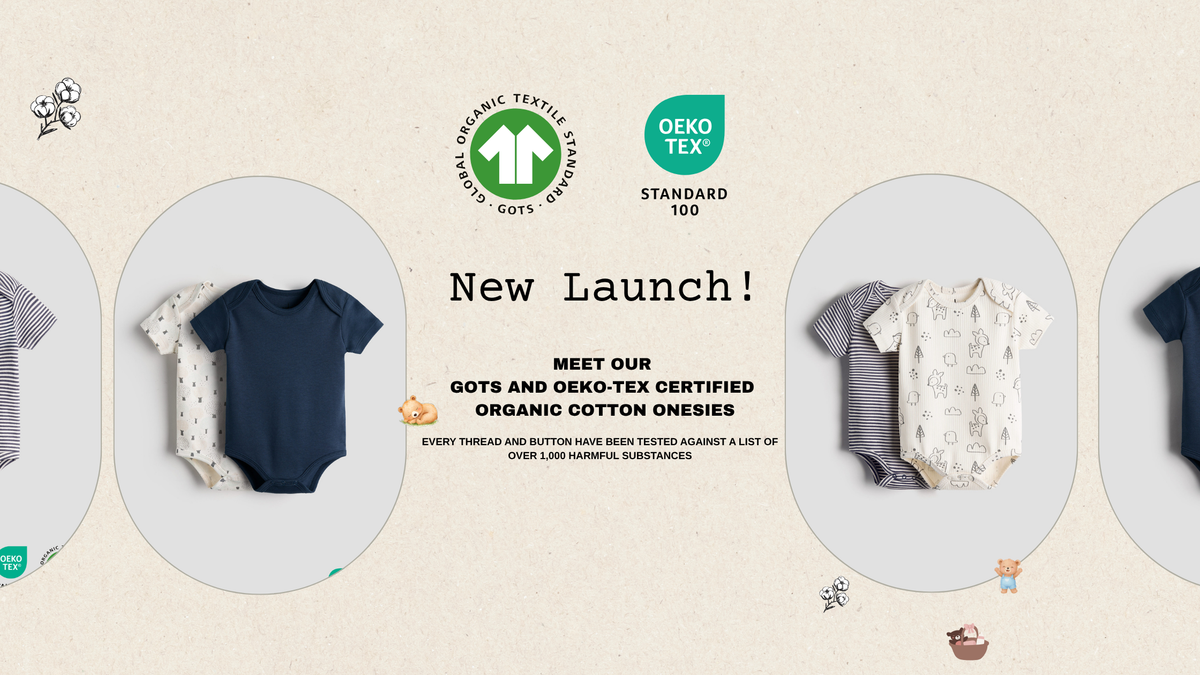
This is why we pursued dual certification at Cozy Bear — each certification covers gaps the other doesn't.
Other Certifications You'll See in India
Organic Cotton Certifications
India Organic (NPOP): National Programme for Organic Production — certifies organic farming practices in India. Valid but only covers raw cotton, not textile processing.
USDA Organic: US Department of Agriculture certification. Reputable but primarily for agricultural products, not textile processing.
General Textile Certifications
ISO 9001: Quality management certification. Doesn't specifically address organic content or chemical safety.
BIS (Bureau of Indian Standards): Indian standards for textiles. Covers basic quality but not organic or chemical-free claims.
Certifications to Be Cautious About
"Self-certified organic": Not a real certification. No third-party verification.
"Natural" or "Pure Cotton": Marketing terms with no legal definition. Cotton can be natural but grown with pesticides.
Expired certificates: Always check the validity date. Certifications require annual renewal.
Red Flags When Shopping for Organic Baby Clothes in India
Based on our research, here are warning signs that a brand's organic claims may be unsubstantiated:
-
No certificate numbers provided. Legitimate certifications have verifiable numbers.
-
Certificates that can't be verified online. Both GOTS and OEKO-TEX have public databases.
-
Vague claims like "organic cotton" without specifying certification. Ask which certification body verified it.
-
Prices that seem too low. Certified organic cotton costs 20-30% more than conventional. If prices don't reflect this, question the source.
-
No information about manufacturing location. Certified supply chains are traceable.
-
Customer service can't answer certification questions. Brands with legitimate certifications train their teams.
How to Choose Certified Baby Clothes: A Practical Checklist
When shopping for your baby's clothes, use this checklist:
Before Purchase
- Does the product page mention specific certifications (GOTS, OEKO-TEX)?
- Are certificate numbers visible or available on request?
- Can you verify the certificate in the official database?
- For OEKO-TEX, is it Class I (for babies)?
- Is the manufacturing country disclosed?
Questions to Ask the Brand
- "What is your OEKO-TEX certificate number and product class?"
- "Which certification body audited your facility?"
- "Can you share a copy of your current certificate?"
Reputable brands will answer these questions readily. Hesitation or vague responses are red flags.
The True Cost of Certified Organic Baby Clothes
Let's address the elephant in the room: certified organic baby clothes cost more. Here's why:
Organic Cotton Farming:
- Lower yields than conventional farming (no synthetic fertilizers)
- More labour-intensive (manual pest control)
- Certification costs for farmers
- Premium: 20-30% higher than conventional cotton
Certified Processing:
- GOTS-compliant dyes cost more than conventional dyes
- Wastewater treatment infrastructure required
- Annual audits at every facility in supply chain
- Certification fees
Ethical Manufacturing:
- Living wages (not just minimum wages)
- Safe working conditions
- No overtime exploitation
- Social compliance audits
For a typical baby onesie:
- Conventional cotton onesie: ₹200-400
- Self-claimed "organic" onesie: ₹300-500
- Verified GOTS-certified onesie: ₹500-800
- Dual GOTS + OEKO-TEX certified onesie: ₹600-1000
The premium reflects genuine costs, not just marketing markup. Brands offering "certified organic" at prices matching conventional products warrant skepticism.
Caring for Certified Organic Baby Clothes
To maintain the integrity of organic fabrics:
Washing:
- Use gentle, fragrance-free detergent
- Wash at 30-40°C (no hot water needed)
- Avoid fabric softeners (they coat fibres with chemicals)
- Wash similar colours together
Drying:
- Air dry when possible (extends fabric life)
- If using dryer, use low heat
- Remove promptly to minimize wrinkles
Storage:
- Store in breathable cotton bags, not plastic
- Keep away from direct sunlight
- Cedar blocks instead of mothballs for pest control
Organic cotton actually becomes softer with each wash, unlike synthetic blends that degrade.
Frequently Asked Questions
Is GOTS certification mandatory for organic baby clothes in India?
No. India has no mandatory certification requirement for "organic" clothing claims. This is why third-party certifications like GOTS are important — they provide the verification that regulations don't require.
Can a product be OEKO-TEX certified but not organic?
Yes. OEKO-TEX tests for harmful substances in the finished product but doesn't verify organic content. A polyester product can be OEKO-TEX certified. Always check for GOTS if organic cotton matters to you.
How often are GOTS and OEKO-TEX certifications renewed?
Both require annual renewal. GOTS involves on-site facility audits. OEKO-TEX requires product re-testing. Always check certificate validity dates.
Are Indian organic baby clothing brands as good as international ones?
Certification standards are identical globally. A GOTS certificate from India meets the same requirements as one from Germany or the USA. What matters is verification, not origin.
Why do some brands have GOTS certification for fabric but not finished products?
GOTS certification is facility-specific. A brand might source GOTS-certified fabric but manufacture in a non-certified facility. For full assurance, the entire supply chain should be certified.
Is "organic cotton" the same as "certified organic cotton"?
No. "Organic cotton" is an unregulated marketing term. "Certified organic cotton" (with GOTS or equivalent certification) means the claim has been verified by an independent third party.
How do I know if a certification logo is genuine?
Genuine certification logos include license/certificate numbers. Verify these numbers in official databases (GOTS public database or OEKO-TEX Label Check). Logos without numbers or unverifiable numbers are likely fraudulent.
Are there specific certifications for baby products vs adult clothing?
OEKO-TEX has product classes — Class I is specifically for baby products (up to 36 months) and has the strictest limits. GOTS doesn't have baby-specific classes but its standards are stringent enough for infant use.
Conclusion: Making Informed Choices
Baby clothing certifications aren't just marketing — they represent real differences in how products are made and what they contain. In a market where "organic" claims are often unverified, certifications like GOTS and OEKO-TEX provide the assurance parents need.
Key Takeaways:
- GOTS certifies organic content and ethical production
- OEKO-TEX Standard 100 certifies absence of harmful chemicals
- Both together provide the most comprehensive assurance
- Always verify certificates in official public databases
- Price reflects reality — certified organic costs more for legitimate reasons
Your baby's skin deserves the safest fabrics. With the knowledge to verify claims, you can shop with confidence.
At Cozy Bear, we maintain both GOTS and OEKO-TEX certifications because we believe Indian parents deserve the same standards available internationally. Our certification details are available anytime, and we welcome verification questions at orders@thecozybear.in or in whatsapp.
References and Resources
Official Certification Databases:
- GOTS Public Database: global-standard.org/public-database
- OEKO-TEX Label Check: oeko-tex.com/en/label-check
Further Reading:
- Global Organic Textile Standard Official Website: global-standard.org
- OEKO-TEX Official Website: oeko-tex.com
- Textile Exchange Organic Cotton Market Report: textileexchange.org
Last updated: January 2026